
Helixio, DNA-seq service provider
DNA sequencing (DNA-seq) allows reading and analyzing the genetic information contained in a sample. This approach is used in many fields, most commonly to identify genetic variants between individuals or between samples. Depending on the objectives of the study, different strategies can be implemented.
The sequencing depth is adjusted according to the objectives of the project, the organism studied and the specific requirements of the analysis.
We offer different protocols adapted to the nature of your samples and the objectives of your study, which allow in particular the use of low quantity and low quality samples. We support you in choosing the most suitable solution for your project.
- Whole Genome Sequencing (WGS)
A complete view of the genome
Whole genome sequencing (WGS) allows the resequencing of any genome (eukaryote and prokaryote).
It identifies a wide range of point and structural genetic variations, such as nucleotide polymorphisms (SNP), mutations, insertions and deletions (InDels), copy number variations (CNV), as well as inversions and translocations.
For organisms without a reference genome, we propose de novo assembly strategies, with functional annotation according to the most relevant databases.
- Whole Exome Sequencing (WES)
A targeted approach to coding regions
Exome sequencing (WES) specifically targets protein coding regions, which concentrate a large part of the known variants.
This approach makes it possible to reduce the volume of data generated. WES is the preferred approach to identify rare variants through increased sequencing depth.
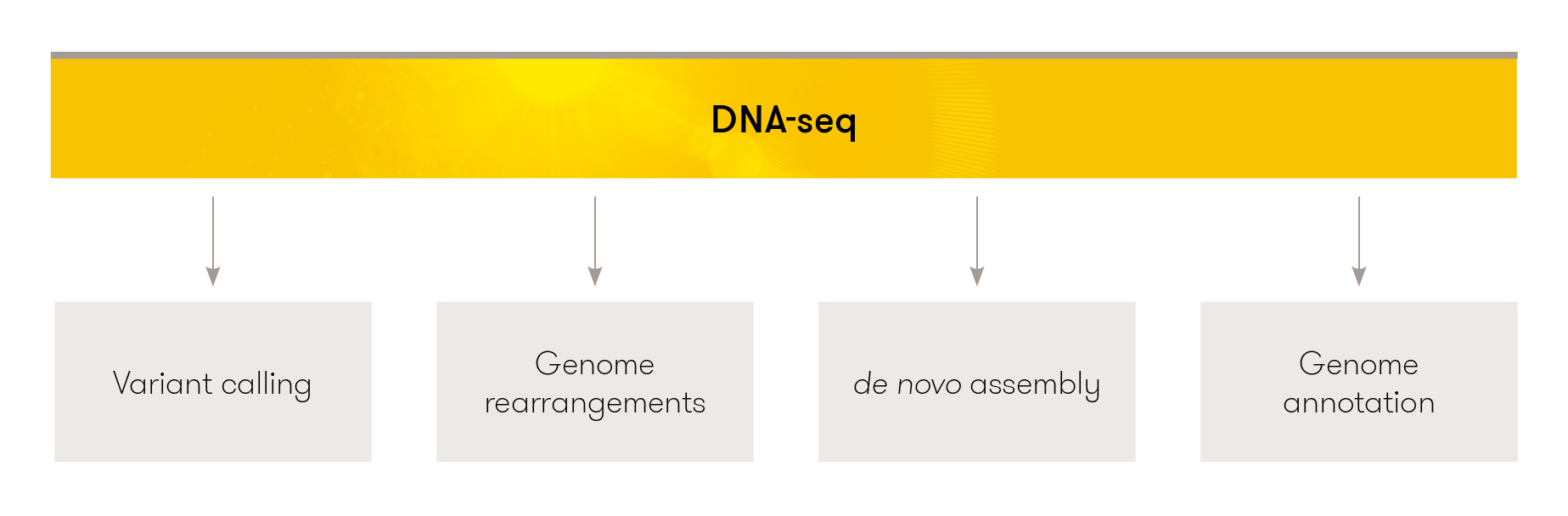
For data analysis, such as alignment on the reference genome, variant analysis or de novo assembly, visit our bioinformatics page!