
Helixio offers epigenetics services
The study of epigenetic mechanisms provides a better understanding of the regulatory processes of gene expression, notably through the analysis of DNA methylation, post-translational modifications of histones and chromatin accessibility.
These approaches make it possible to perform a wide variety of analyses, such as the identification of differentially methylated regions, the characterization of epigenetic regulatory profiles or the prediction of patterns associated with regulatory elements.
To obtain an integrated view of cellular regulation mechanisms, epigenetic analyses can be combined with RNA-Seq. This approach allows us to relate the epigenetic modifications observed with their functional consequences on gene expression.
- Methyl-seq (methylation sequencing)
Analyze the DNA methylation marks
Methyl-seq allows to explore the methylome by identifying DNA regions with methylation marks at the genome scale or on specific areas of interest. Among them, the methylation of cytosines (5mC) located in CpG sites or CpG islands close to the transcription promoter regions.
A change in the level of methylation can influence gene expression by interfering with transcription factor binding or modifying chromatin structure. The comparison of the profiles of several samples allows to highlight the differentially methylated regions (DMR).
- ChIP-seq (Chromatin Immunoprecipitation Sequencing)
Map the interactions between DNA and regulatory proteins
ChIP-Seq allows the identification, at the genome scale, of binding sites between DNA and proteins of interest, such as transcription factors, cofactors or chromatin-associated proteins.
This approach allows to localize the genomic regions involved in transcriptional regulation, to characterize histone modifications and to identify regulatory elements associated with different transcriptional states. The ChIP-Seq thus offers a global view of the functional organization of chromatin and the mechanisms controlling gene expression.
- CUT & RUN - CUT & Tag
Decipher DNA–protein interactions with increased accuracy
The CUT&RUN (Cleavage Under Targets & Release Using Nuclease) and CUT&Tag (Cleavage Under Targets and Tagmentation) approaches allow to map with great precision the interactions between DNA and chromatin proteins. After targeting a protein of interest by immunoprecipitation, these techniques allow us to study histone modifications, transcription factors and cofactors involved in transcriptional regulation.
They offer an alternative to classical ChIP-seq approaches by requiring less biological material and by limiting the preparation steps, notably the absence of cross-linking and the reduction of chromatin fragmentation steps.
- ATAC-Seq (Assay for transposase accessible chromatin)
Map the open and active regions of the genome
ATAC-Seq identifies the chromatin regions accessible to transcriptional regulatory complexes. This approach allows the mapping of promoters, enhancers, nucleosome positions and potential transcription factor binding sites in different cell types. It is now a reference method for studying chromatin dynamics and epigenetic regulation mechanisms during biological processes.
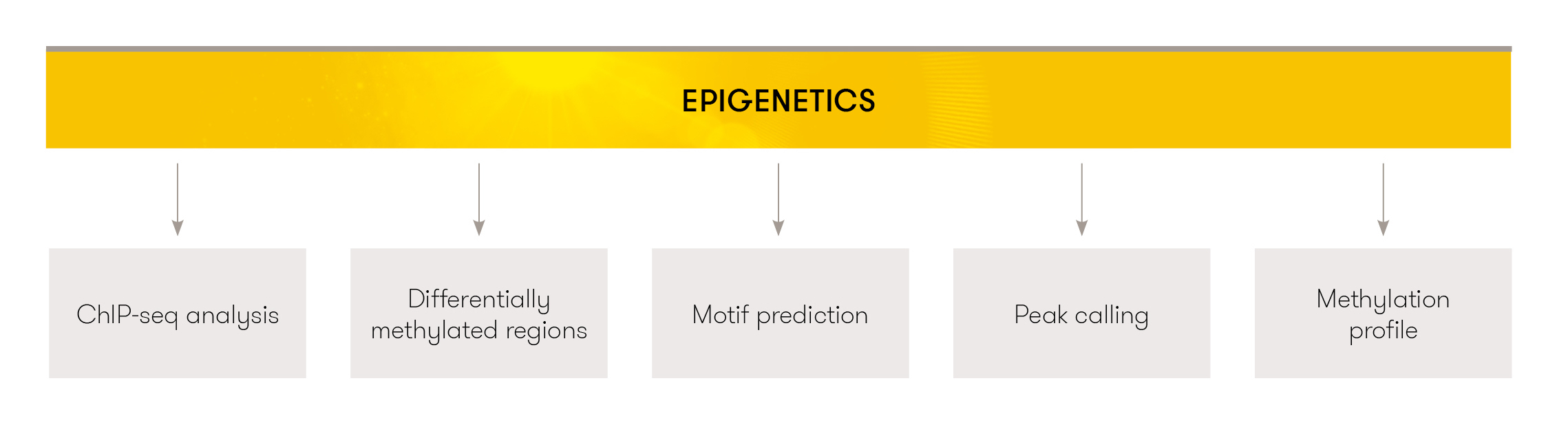
For data analysis, including identification of epigenetic signatures, pattern prediction, and peak calling detection and annotation, visit our bioinformatics page!